


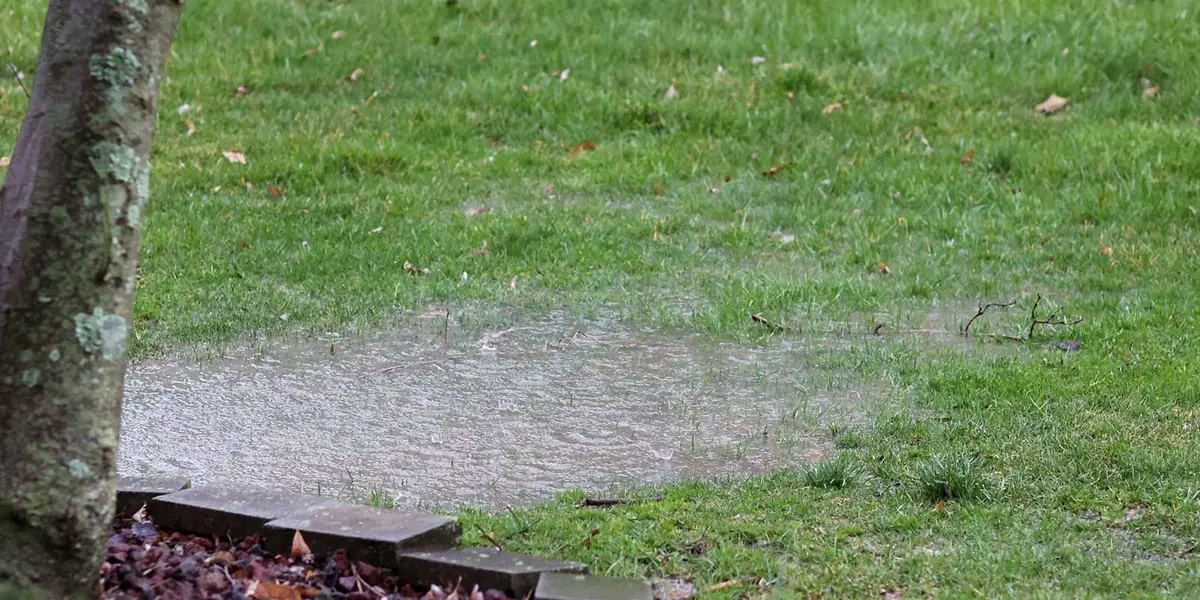
A sprinkler system that worked fine in one season can cause real problems when the season changes. The fix is almost never the system itself. It is the programming.
Cycle and soak matters no matter what time of year it is. That means running a zone for shorter periods with breaks in between rather than one long soak, so water has a chance to absorb instead of running off. That principle never changes. What does change, season to season, is how many days a week you water and for how long. During dry stretches, you water the full amount your local ordinance allows. During the rainy season, most municipalities drop that down to a single watering day per week. Right now Southwest Florida is also under a drought-driven restriction limiting outdoor watering to one day a week across much of the region, separate from the normal seasonal pattern. Restrictions like this shift with conditions, so always check your current local watering schedule rather than assume last year's rule still applies.
Before we trust any system’s programming, we start with the system itself. The first thing we check is distribution uniformity, which is simply how evenly water is applied across a zone. Done wrong, some areas go dry while others get soaked, and you end up chasing dry patches while overwatering everything else. Overwatered turf invites fungus. Underwatered turf invites chinch bugs. (UF/IFAS Extension lists fungus among the signs of overwatering, and notes that chinch bug damage shows up first in water-stressed grass.) Both start the same way, with a system that was never applying water evenly in the first place.
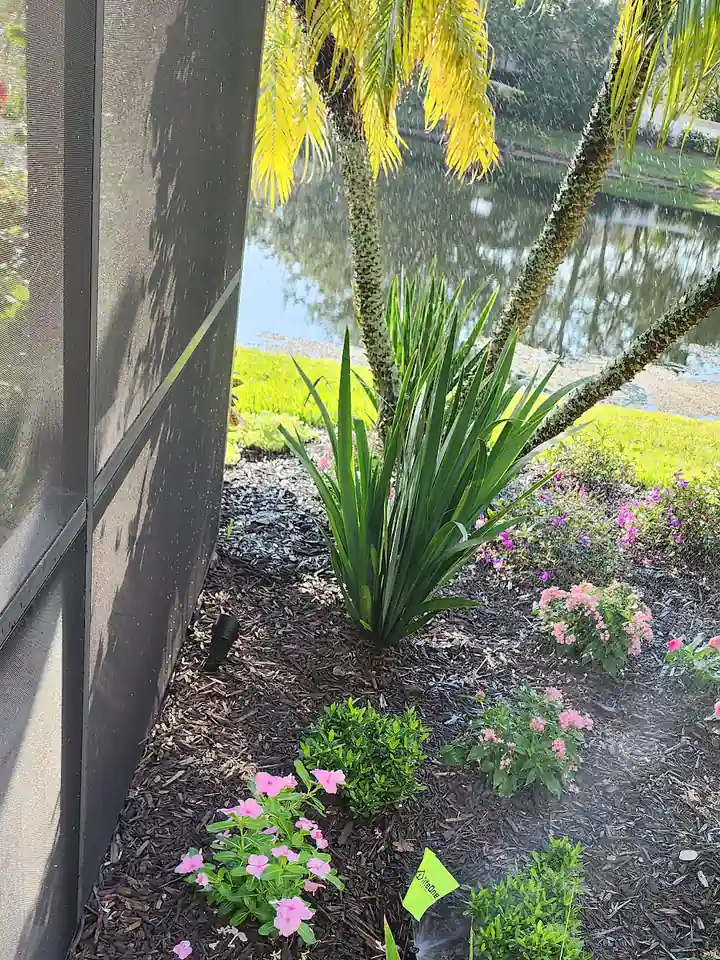
We hold every system we design to three rules. First, turf and landscape plant material never share a zone, because they need different watering approaches entirely. Second, spray heads and rotors never mix on the same zone, because they apply water at different rates and create uneven coverage. Third, landscape beds get watered with low volume, either drip irrigation or Maxi-Jet emitters. Drip costs more to install but is more efficient and invisible once it is in the ground. Maxi-Jets cost less and homeowners tend to like them because they can actually see water being applied, though some consider them unsightly since they sit about 12 inches above the soil, spaced roughly every 24 inches.
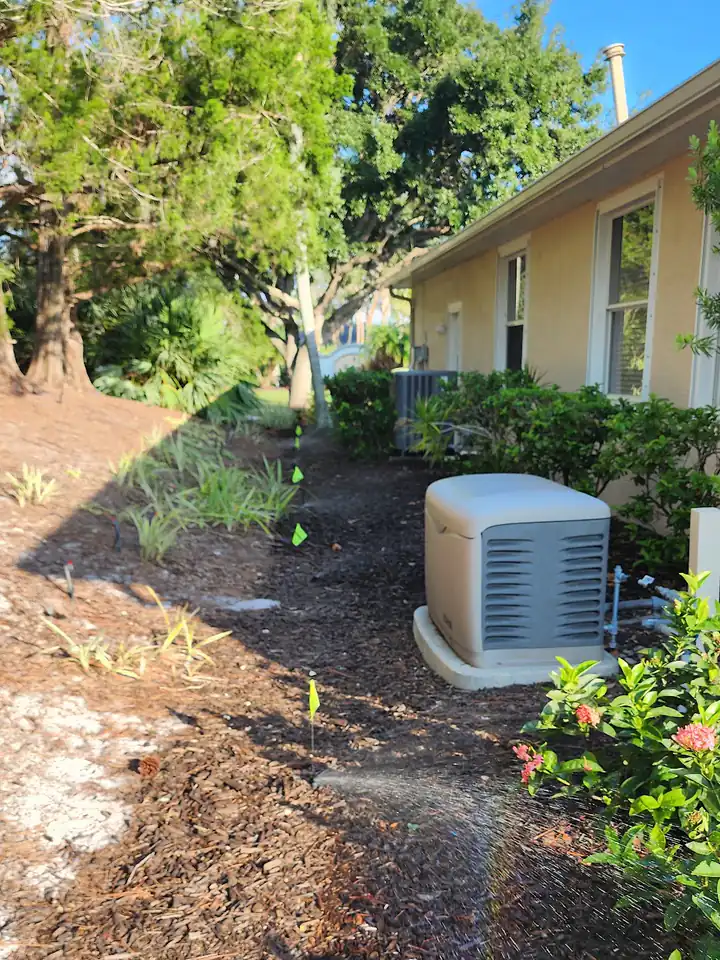
The simplest way to catch a poorly designed zone is to turn the whole system on and watch it. A well-designed zone uses head-to-head coverage, meaning each sprinkler's spray reaches the next head over. Too many systems are designed with spray-to-spray coverage instead, where heads only reach partway to each other. That might look fine when every head is working, but the moment one head fails, an entire section of the yard gets no water at all. It is a bad practice, and it is common. We also look at upgrading older rotor and spray heads to MP Rotator nozzles wherever it makes sense. They apply water in multiple fine streams rather than a single heavy stream, which cuts runoff and improves uniformity, and they use up to 30% less water than standard spray nozzles.
For clients who want to go further, we offer a catch can test or use a handheld moisture meter, a FieldScout TDR 350, that measures volumetric water content at different soil depths and logs it with built-in GPS. Run across a property, it builds a full soil moisture map so we can see exactly where a zone is under or overwatering, rather than guessing from dry patches on the surface.
We do roughly 60 irrigation upgrades a year in the Lakewood Ranch area, and most of them exist because the original system was never designed to the standard Appendix F of the Florida Building Code lays out. That code has only become more widely followed by installers in recent years. Even now, plenty of installers chase the lowest price instead of building it right the first time. Nationally, a single irrigation zone typically runs $590 to $1,340 to install, depending on the market and site conditions (Lawn Love sprinkler system cost guide). Genesis charges $1,200 to $2,000 per zone. That gap is real, and there is a reason for it.
New construction crews install into an open, bare lot. They can run a wide trencher straight through dirt with no existing lawn to protect and little concern about what is buried underground. We almost never get that luxury. Most of our work goes into an established, living lawn, so we use a narrower, two-inch disc trencher instead of a wide chain trencher, specifically to minimize damage to turf that is already there. The tradeoff is that our cleanup takes more time and more care. The payoff is that within two to four weeks, the lawn knits back together and the trench lines disappear completely.
A system installed fast and cheap on an open lot is not the same product as a system installed carefully into an existing yard, and the price difference reflects that difference in the actual work, not just in the parts.
We handle irrigation and water management. If your yard's issue involves turf health, plant selection, or soil amendment, that is a conversation for your landscaper or your county extension office, not us.
Genesis exists to help support Kai'Ros House, an orphanage we are connected to in Kumasi, Ghana. We say that plainly, not looking for sympathy, just stating why Genesis does what it does.
If your system was installed on price alone, it is worth having someone evaluate what it is actually doing in your yard, not just whether it turns on and off on schedule.
Genesis Sprinklers & Water Management LLC
(833) 543-6374
[email protected]
5320 Lena Rd Ste 104, Lakewood Ranch, FL 34211
"For which of you, intending to build a tower, sitteth not down first, and counteth the cost, whether he have sufficient to finish it?" Luke 14:28, KJV
